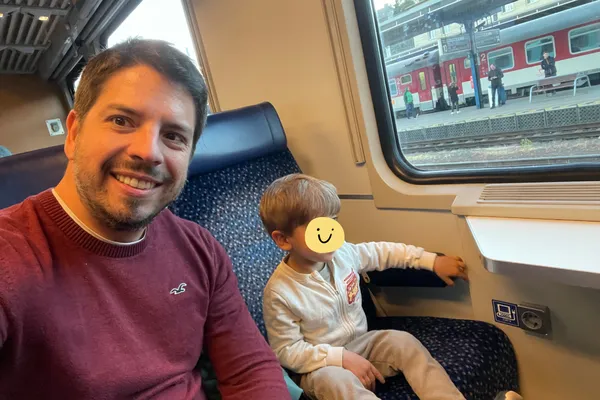
The week my son was born, my team delivered $30K without me
I was afraid we might drop the ball on the project, hurting our relationship with the client and also our reputation in the market.
Growth felt risky.
Every time I tried to step back, something would happen, and I would be pulled back into the project to ensure things were delivered as promised.
It was frustrating to have people who wanted to work with us. I knew we could help them, but I was afraid to say yes.
I needed to make a decision.
If I said no, somebody else was going to say yes, and they wouldn’t come back.
If we said yes, we could disrupt all of our projects… oooor we may not
With my first son coming in 5 months, I wanted to say yes and cash in, but I also knew my time was about to get very, very, very limited.
So, like any entrepreneur, I said yes.
And set out to figure out a way to serve them all.
Not all leads are created equally.
There are 2 ways to reach capacity in an agency.
And only one is scalable.
So before you go on saying YES to everybody, this is key.
Scenario 1
You have every lead come to you looking to:
Solve the same problem,
Wanting the same outcome,
And therefore, you sell them the same service to all of them.
For example, you sell live video production to events looking to engage their audience online.
Scenario 2
Every lead comes with:
A different problem,
Wanting a different outcome,
Requiring you to repackage your skills into a different solution.
For example, you sell video production to companies that want:
Event videos,
Company videos,
Testimonial videos,
Product videos,
YouTube commercials,
etc.
They all seem like the same thing because it’s video, but the problem to solve, the skills required, and the goals to achieve are all very different
The first one is scalable.
The 2nd one burns you out.
I know this because back in 2019, that's what got me burned out.
But now, it’s two years later, and I understand what scaling is all about.
It's not about being able to deliver many different services to many people. It's about doing ONE thing for many clients without dropping quality.
This is what got me to hit Scenario 1.
So, deciding to say yes to those leads made perfect sense.
Growth wasn't risky because I had engineered it.
And it was all thanks to 3 systems I had built:
A Signature Service
An Internal Brain
A Central Hub
Now it was time to stress test them.
The Signature Service
After burning out at the end of 2019, I decided to simplify things.
So I eliminated all our services except for one, live video production.
This meant saying no to every project that wasn’t live video production.
No more repacking our skills to come up with something we could sell.
At first, it was tough, but I was determined to get out of the job I had built for myself.
And since everything I was told to do hadn't worked, I couldn't see another way.
To my surprise, within weeks, things turned around.
Clients began to see us as the experts with the proven solution. This made it easier to close more of the right projects. Soon enough, random revenue was replaced with more projects with the same ideal client.
Taking us from every project starting from scratch, to every project building on the last one.
Allowing me to turn delivery into a system that was easy for others to follow. Providing clients with a valuable experience without me being a part of it.
And that’s where the Internal Brain came in.
The Internal Brain
Since my very attempt at the business in 2017, I knew documenting processes was key.
I had tried to write SOPs on Google Docs, but I never found a way to use them. Our processes weren't clear enough for the SOPs to be relevant.
We were figuring things out so the SOPs became obsolete with every new project.
On top of that, there was no culture in the team to use them.
That all changed with the Signature Service, and understanding this.
SOPs make sense for bigger businesses with large teams, where roles and processes are clear.
In a small business, SOPs make no sense. An SOP only provides a snapshot of a process. It doesn't give an overview of the workflow.
In a small team, it's crucial for the first employees to know what happens in the business. They need to visually see the processes and understand how everything comes together.
So I ditched the Google Docs that kept getting too long or lost. And began extracting my philosophies, my way of doing things, my beliefs.
Now I could teach my team how to make decisions, what to aim for, where to draw the line.
Performance began to go up, I began to trust them, and I gave them more space to own their roles.
Then came the cherry on top, the Central Hub.
The Central Hub
I had tried using Asana, Trello, Airtable, Slack, Email, in-person, Google Docs, Etc. as a way to manage projects and communicate with clients.
I had freelancers, clients, and team members, all of whom needed to collaborate and communicate.
I need to track projects.
I thought the problem was the tool, so I kept looking for the one that looked like the most scalable. That just left me wasting time trying to figure out ways to implement features we didn't need.
It's a service business. Simplicity is fundamental.
All we needed was a way for everybody to come together without me being at the center of it.
Basecamp was perfect. Normally used by IT agencies, it wasn't popular in the creative space.
But it was perfect for getting my team connected with the client without me losing the overview.
As they started to embrace their new authority, they stepped up. Performance improved, and so did the value for clients. Now, they didn't need to wait for me to do quality control.
Allowing us to provide each client with a world-class experience every single time.
The Real Test
On May 4th, 2021, my son was born. As I jumped in the Uber to go to the hospital at 7 a.m., I texted the team.
"Not gonna make it today; Mateo is coming."
They said, "No worries, we got this."
At the end of the day, I called the team, and they were super happy with the project. No surprises to manage.
Then, I called the client, and they were super happy with the team's performance.
This was a full-day production with an 8-person team.
I couldn't believe it.
After 4 years, I had finally figured it out.
I was out of delivery.
That week, while Mateo was being born, the team delivered over $30k in projects without me setting foot in a single one.
That became the status quo moving forward.
Clients were amazed by how easy it was to integrate our services, how professional the projects were, and one even offered to invest in the business.
Taking Action
After getting married in 2017, I knew it was a matter of time before we would start having kids. That pushed me every day to figure out a way to transition from self-employed to business owner.
There will be a moment in your life you just want to be present for, a birth, a diagnosis, a trip, a morning... The business will always feel like it needs you but it doesn’t have to be that way.
So the question isn't whether that moment is coming, but whether your business will be ready when it does.
Complexity makes that impossible by keeping everything dependent on you.
You set out to turn your expertise into a business that would allow you to earn more while working less. Now, you can’t disconnect on the weekends out of fear something will fall through the cracks.
Make eliminating complexity your priority and everything else will follow.
